2026 FVSV Workforce Pulse Survey(external link)

The Centre for Family Violence and Sexual Violence Prevention is inviting responses to the 2026 FVSV Workforce Pulse Survey, to better understand Aotearoa New Zealand’s family violence and sexual violence workforces. 

This survey provides an opportunity for people working in the family violence and sexual violence system to share their experiences, which will help us understand and work towards strengthening the workforce. The survey gathers information that helps us report on progress towards the moemoeā (vision) of Te Aorerekura – The National Strategy for the Elimination of Family Violence and Sexual Violence

The survey is open until 16 October 2026 and we encourage sharing so that more people can participate. The findings will be reported and published online in early 2027 on the Centre’s website.

Who should participate?

People who offer paid or unpaid support to people impacted by family violence and/or sexual violence or to people who have used violence.

This includes, but is not limited to, advocacy, social work, counselling, legal and justice responses, housing support, health and addictions services, whānau-centred responses, rehabilitation, healing and behaviour change. 

This also includes people who engage in paid or unpaid activities to manage or support staff, or administration, prevention, funding, policy or research roles related to family violence and/or sexual violence.

Why should I participate?  

This is an opportunity for you to share your views on the system and use your voice to shape decision-making in the future. Through understanding how those working in the system are supported to work responsively, safely, and effectively, we can measure our progress in strengthening these workforces. This accountability ensures that our efforts align with our moemoeā (vision), directing resources where they are most needed. 

Te Aorerekura: This is the 25-year strategy designed to eliminate family violence and sexual violence in Aotearoa New Zealand. More information here.(external link)

Survey content

The survey asks some screening questions so we can understand the work of those who complete the survey. It then focuses on questions related to respondents’ knowledge and skills, safety, job satisfaction, and relationships in the sector. 

This survey takes 20 to 30 minutes to complete.

Voluntary and confidential
Participation in this survey is entirely voluntary. Your responses will remain confidential, and no attribution will be made to individual participants.

Click HERE (external link)to do the survey now. Thank you!

The survey responses will be securely stored by the Centre for Family Violence and Sexual Violence Prevention.  

Workforce Survey Results (PDF) [PDF, 672 KB]
Workforce Survey Data Tables (PDF) [PDF, 449 KB]

Nearly 400
 people participated in the 2025 Workforce Survey, which gathers information from people working in the family violence and sexual violence (FVSV) sectors.
 

The survey ran from August to October 2025 and asked about workers’ access to training, their understanding of how to meet the needs of people affected by FVSV, their perception of relationships with government agencies, and any barriers or emerging issues   

The survey results help the Interdepartmental Executive Board for the Elimination of Family Violence and Sexual Violence to:

The OMF describes twelve national outcomes. These outcomes are the long-term changes needed for the moemoeā to be realised. Each long-term outcome is supported by several shorter-term changes we expect to see in the next five or more years. Part of measuring these outcomes includes understanding the FVSV workforces. 

About the 2025 survey  

The 2025 Workforce Pulse Survey was a follow-up to the longer 2024 survey and focused on questions to help the Executive Board measure how well the Action Plan has made progress towards the moemoeā (vision) of Te Aorerekura.  

Respondents included a range of frontline and back-office roles, those who work in FV and SV, and government and non-government organisation workers. Most respondents worked for a government organisation (44%) or non-government organisation (41%), and 5% worked for a Kaupapa Māori or iwi/hapu organisation group. 

Key findings 

  • Over three quarters of the surveyed workforces (78%) rated their understanding of how to meet the needs of people, whānau and families impacted by family violence and/or sexual violence as "good" or "very good“. Non-government and frontline workers overall rated their understanding higher than government workers and back-office workers. 

  • Over half (62%) of respondents felt they “often” or “always” had access to training, guidance, information, and resources to support them to develop in their role. Non-government workers overall reported better access to this development support than their government counterparts. 

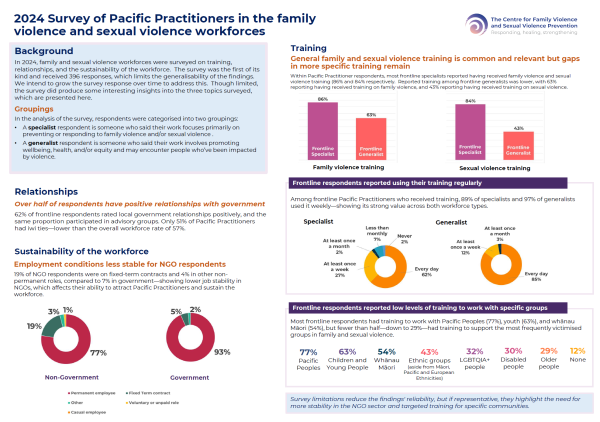
  • Most respondents had training for working with whānau Māori, youth, and rainbow communities, but fewer than half had training to support other specific community groups - Pacific peoples, Disabled people, Ethnic communities, and older people. 

  • Less than half (48%) of the non-government respondents reported a positive relationship with local offices of government agencies, and only a quarter (26%) reported a positive relationship with national offices. 

  • When asked about training, barriers, and emerging issues, key themes emerged from respondents, including: 

    • A strong call for more training and support in a range of areas such as working with users of violence, trauma informed care, working with children, and working with specific population groups 

    • Desire for a shift to evidence-based prevention efforts, rather than reactivity. 

    • Significant concerns about funding. 

    • Noting the increase in socioeconomic factors that contribute to family violence and/or sexual violence. 

    • A need for better collaboration, communication, and connection across the sector, many saw training as a potential opportunity to learn from each other.  

    • Noting the rise in online and technology-facilitated harm. 

    • Noting the rise in elder abuse. 

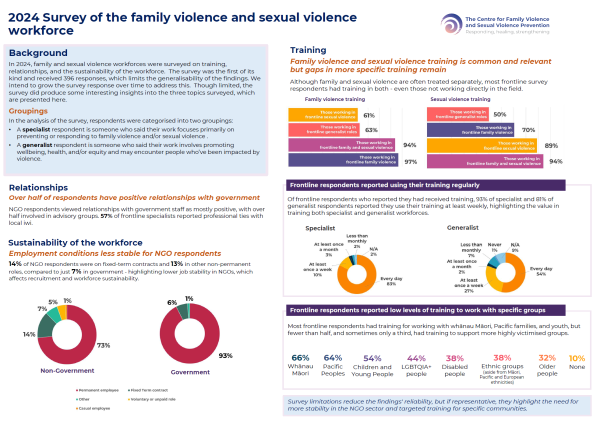
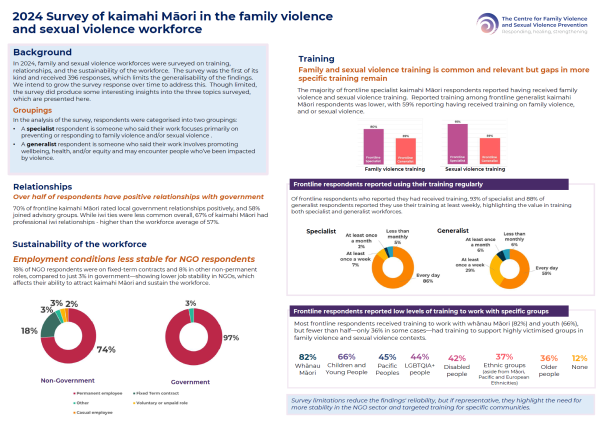
In May and June 2024, nearly 400 people working across Aotearoa New Zealand’s family violence and sexual violence (FVSV) sectors took part in the FVSV Workforce Survey. Their voices have helped build a clearer picture of who makes up the workforce, the challenges they face, and the support they need to thrive.

The survey was a joint initiative between The Centre for Family Violence and Sexual Violence Prevention and ACC, designed to inform progress towards the Outcomes and Measurement Framework of Te Aorerekura and support ongoing workforce development.

Key Findings

  • Diverse and dedicated: Respondents included frontline and back-office workers, specialists and generalists, government and NGO staff. 80% identified as women, with strong representation from Māori (23%) and Pacific peoples (34%).
  • Training and capability: While many had received recent training, especially in family violence, fewer had training aligned with the Te Aorerekura Capability Framework. Access to relevant information and resources varied widely.
  • Relationships and wellbeing: Most respondents rated their relationships with local government staff positively, but relationships with national offices were more mixed. 65% reported good or very good wellbeing at work.
  • Community-specific training: Many had received training to work with whānau Māori, Pacific families, children and young people, and LGBTQIA+ communities—but gaps remain.

Why This Matters

The FVSV Workforce Survey is a vital tool for understanding the needs, strengths, and experiences of those working to prevent and respond to violence in our communities. It helps ensure that workforce development is grounded in lived experience and supports continuous improvement across the sector.

[PDF, 1 MB]

[PDF, 235 KB]

[PDF, 200 KB]

[PDF, 196 KB]

Last modified: